Frequently Asked Questions
What is DIN SPEC 91489:2024-11?
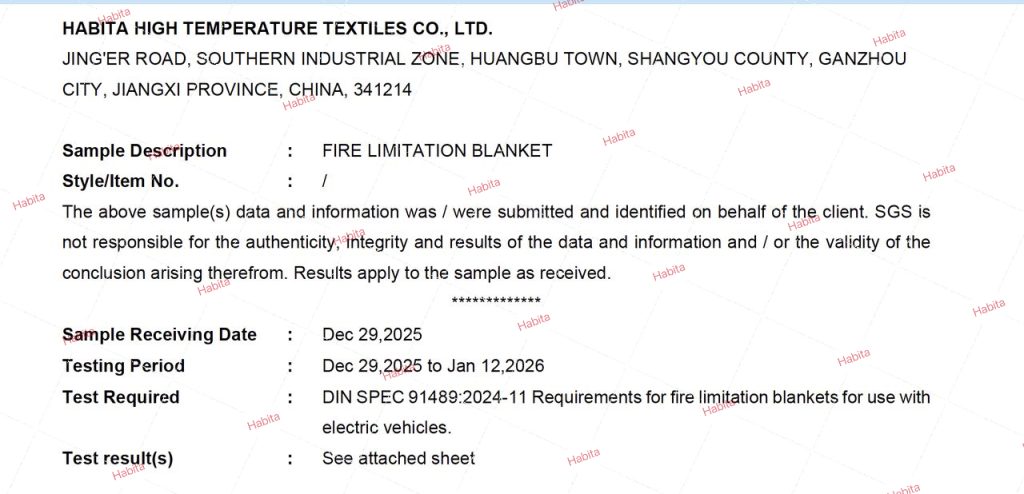
DIN SPEC 91489:2024-11, the world’s first standardized testing and technical requirement standard for fire limitation blankets specifically designed for electric vehicles, was jointly formulated by the Deutsches Institut für Normung (DIN) in collaboration with fire safety experts, emergency response departments, automotive manufacturers, insurance institutions, testing organizations and other relevant parties, and officially released in November 2024. Its full title is 《Requirements for fire limitation blankets for use with electric vehicles》
What is the significance of the DIN SPEC 91489:2024-11?
The release of DIN SPEC 91489:2024-11 is centrally significant for filling the global gap in dedicated standards for electric vehicle fire limitation blankets, establishing stringent performance and testing benchmarks, providing regulatory assurance for emergency response, driving the standardized upgrading of the industry, and leading the coordination of international standards, thus comprehensively supporting the improvement of the fire safety system for electric vehicles.
A brief overview of DIN SPEC 91489:2024-11 certification requirements
As the world’s first certification standard for fire limitation blankets exclusively designed for electric vehicles, DIN SPEC 91489:2024-11 covers five core dimensions of certification requirements: component specifications, performance testing, general compliance, marking and documentation, and test evidence. All indicators are mandatory pass items. Below are the detailed certification requirements by dimension (with core test standards and quantitative metrics attached):
I. Special Component Specification Requirements
1. Loop Straps
– Layout and dimensions: Fitted at all four corners with dimensions meeting the minimum value specified in the standard;
– Flammability: Low flammability proven by passing the FMVSS 302 test;
– Color code specification: Straps on the pulling side shall be red, and all other straps in a different color (for visual differentiation);
– Performance requirements: Pass the strength test, with firm fastening to the blanket body and compliance verified through testing.
2. Positioning Markers
– The center point shall be clearly marked on all sides of the blanket body to ensure accurate positioning during emergency deployment.
II. Core Performance Testing Requirements
1. Thermal Resistance
– Basic rating: Tested in accordance with EN ISO 13501-1, with a minimum passing rating of B, s1, d0 (low flammability, no smoke emission, no dripping);
– Special simulation test: The blanket body is placed over a metal frame equipped with two gas burner torches and thermocouples, and subjected to multi-cycle high-temperature testing at 700–1000°C to simulate the thermal runaway scenario of electric vehicle batteries, with stable performance required throughout the test.
2. Mechanical Stability
– Cut resistance: Tested in accordance with EN ISO 13997 and meeting the specified rating of the standard;
– Tensile strength: A 100kg weight is first applied for 30 seconds under constant pressure, followed by an impact test with a 25kg weight dropped from a height of 30cm. After standing for 30 seconds, the blanket shall show no tearing, fraying or component detachment.
III. General Compliance Requirements
1. Surface finishing: All open edges of the blanket body shall be treated to prevent fraying and eliminate loose threads;
2. Performance labeling: The product service life and reusability shall be clearly specified;
3. Special testing: Pass the radio frequency permeability test with no adverse effects related to signal shielding;
4. Corrosion resistance: Resistant to corrosion by oils, greases, fuels, fire-extinguishing agents and battery acid;
5. Physical performance: Pass the flexibility test and storage deformation test, with no functional failure during long-term storage or use;
6. Deployment efficiency: For vehicles of specified dimensions under both dry and wet conditions, full deployment shall be completed within 30 seconds with a maximum of two operators;
7. Storage protection: The accompanying storage container/bag shall meet the IP65 protection rating (dust-tight and protected against water jets);
8. Material compliance: PFAS (per- and polyfluoroalkyl substances)-free materials shall be used throughout the production process.
IV. Marking and Manufacturer Information Requirements
1. On-body marking: The blanket body shall be fully marked with technical specifications, date of manufacture and batch number, with all information permanently legible;
2. Accompanying documentation: Detailed instructions for use as specified in the standard shall be attached, with content matching the product and complying with relevant specifications.
V. Test Evidence Requirements
1. Test archiving: Written records shall be kept for all required tests, with photographic and video evidence retained simultaneously;
2. Special report: The thermal resistance test report shall be accompanied by professional expert opinions that clearly certify the product’s suitability for use as a fire limitation blanket for electric vehicles, with no disputes over its application scenario.
A Standard for the future
The safety of the public, fire and emergency services, recovery crews, and EV service technicians is paramount to the sustainable growth of the automotive industry.
Whether in a car park, on a vehicle ferry, or in an EV workshop, people need to know they are safe should the worst happen. DIN SPEC 91489:2024-11 certification goes a long way to achieving that goal.
Fire Cloak™ will continue to work with peers, regulators, and fire safety experts worldwide to share knowledge, exceed expectations, and deliver unrivalled solutions to the significant challenges posed by lithium battery fires.